
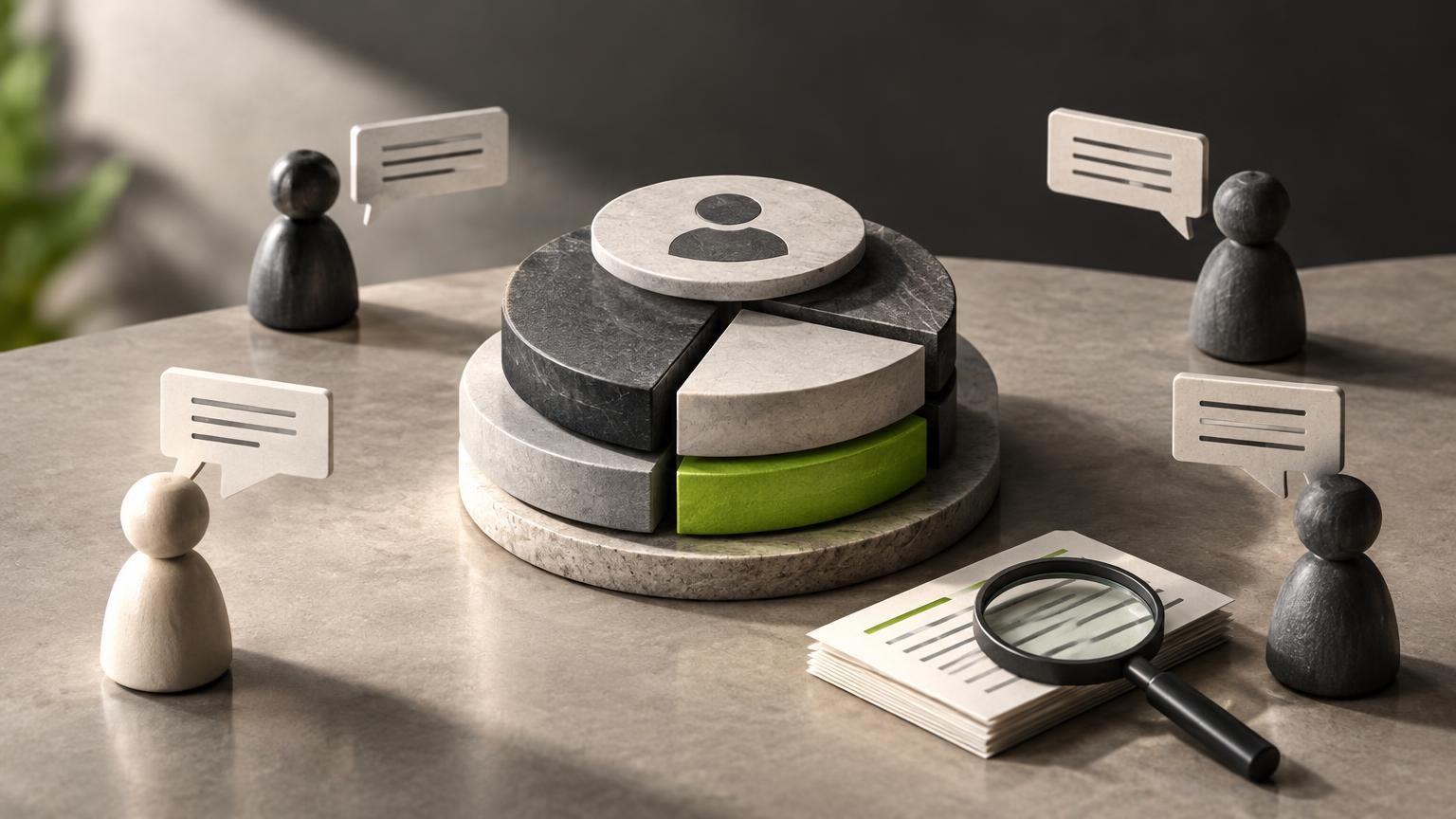
A 360° assessment brings together feedback from a manager, colleagues and direct reports, then sets those perspectives alongside an employee’s self-assessment. The difficult part is not collecting more opinions; it is deciding what those opinions mean and what to do next. Open questions can add observations and examples that a rating alone cannot convey. AI can help summarize those answers for a report, but a summary is still an interpretation of what respondents wrote. Managers need a way to read the report, check its limits and turn it into a fair development conversation rather than a verdict about a person.
Start with the decision, not the questionnaire
Before launching a 360° assessment, decide what conversation the feedback should support. Is the aim to understand how someone’s communication is experienced across a team? To identify a skill worth developing? Or to compare a person’s self-assessment with the perspectives of people who work with them? A clear purpose gives the eventual report a useful boundary.
That boundary matters because feedback can be mistaken for a complete account of performance. Respondents describe what they have noticed from their positions, not every aspect of a colleague’s work. A manager should treat the report as material for inquiry: Which observations are consistent? Which need context? What would be useful to discuss with the employee?
Ratings and examples answer different questions
A rating can make a difference in perception visible. If an employee rates a skill differently from colleagues, that gap may be worth exploring. The score itself does not explain whether people interpreted the question in the same way, observed the same situations or had similar opportunities to work with the employee.
Open questions give respondents room to explain their assessments, share observations and provide examples. They can clarify what colleagues value and where they recommend attention. A comment about communication, for instance, is more useful when it describes a situation or behavior than when it simply labels someone a “strong communicator.”
The two forms of feedback should be read together. Ratings can indicate where to look; written answers can suggest questions to ask. Neither should be treated as proof of a cause. When the written context is vague or inconsistent, the responsible next step is to seek clarification in the development conversation, not to fill the gap with certainty.
What AI adds to an open-response report
Open answers can contain many different ways of describing similar experiences. AI-assisted analysis can help summarize those answers and formulate findings for a report. That makes the written feedback easier to review alongside ratings and self-assessment, especially when the reader needs to distinguish recurring points from individual observations.
Summarization also compresses information. A concise finding may omit a qualification, combine comments that refer to different situations or make a tentative observation sound more settled than respondents intended. These are reasons to read AI-generated conclusions as a guide to the feedback, not as an independent witness to an employee’s behavior.
A practical question for any report is: Can the reader tell which claims are grounded in respondent observations and which are interpretations? If that distinction is unclear, keep the conclusion provisional. The value of AI here is in helping organize human feedback; the judgment about how to use it remains with the people responsible for the conversation.
A workflow from feedback to discussion
A 360° assessment becomes more useful when the manager plans the review before presenting conclusions. The following sequence keeps attention on observations and possible actions rather than turning every difference in the report into a problem to solve.
- Define the development question. Write down what the assessment is meant to inform and what it is not meant to decide.
- Review the perspectives separately. Look at the manager, colleague and direct-report feedback alongside the employee’s self-assessment before drawing an overall conclusion.
- Pair ratings with explanations. For each apparent strength or gap, ask what written observations support it and what context may be missing.
- Read AI summaries critically. Check whether a finding is specific enough to discuss and whether it overstates what respondents actually described.
- Choose a small number of discussion points. Frame them as questions about work situations, impact and possible changes rather than labels about personality.
- Agree on a next step. A development conversation can lead to a practice to try, a learning need to explore or a question to revisit later.
This sequence is a way to structure judgment, not a guarantee that every comment will become actionable. Some responses may be too general to support a concrete next step. It is better to identify that limitation than to manufacture precision from a polished summary.
A hypothetical example: the same score, different context
Consider a hypothetical employee whose self-assessment of communication is more positive than the feedback from colleagues. The difference is a starting point, not a diagnosis. Without written context, a manager cannot tell whether colleagues mean meeting updates, handoffs, responsiveness or something else entirely.
Suppose the open answers describe useful explanations during project planning but less clarity when priorities change. An appropriate discussion would focus on those situations: What information do colleagues need when plans change? What does the employee believe they already communicate? What small change could the team try? The example illustrates how specific observations can turn an apparent disagreement into a workable question.
If, instead, the answers offer only broad judgments with no examples, the report supports a more limited conclusion: perceptions differ, but the reason is not yet clear. The manager can acknowledge the difference and invite context without treating the AI summary as an established account of what happened.
Check the limits before acting
Different respondents see different parts of a person’s work. That is the point of a multi-perspective assessment, but it also means their answers are shaped by their roles and opportunities to observe. A useful review asks where views align, where they diverge and whether the divergence may reflect different working contexts.
Written feedback varies in specificity, too. One detailed example may be more useful for a conversation than several generic comments, but it should not automatically stand in for everyone’s experience. Likewise, a repeated theme warrants attention without proving that every respondent meant the same thing. Read for patterns and exceptions.
Before relying on a report, check how the assessment will be introduced, who will review the feedback and how the employee will have room to respond. These are practical questions for the organization conducting the assessment, not claims that a tool can settle on its own. The aim is to use feedback constructively and avoid presenting an interpretation as an uncontestable fact.
Make the report the start of the work
A useful 360° report brings several perspectives into one development conversation. Ratings reveal possible differences in perception; open answers provide context; AI-assisted analysis helps summarize what respondents wrote. The manager’s task is to distinguish observation from inference, discuss what is actionable and leave uncertainty visible where the feedback does not resolve it.
Sandwich offers 360° assessments with open questions and AI-assisted analysis of responses for reports. If you are considering how that approach might support a development conversation, explore Sandwich at https://sandwichconsulting.com/.